A home that stands the test of time
In the home of Marita and Jarmo Tiirikainen, art and furniture are given the freedom to find their place and develop a beautiful patina over time – including Woodnotes rugs.
Kirsi Kaulanen, Raija Rastas, Sam Vanni, Armas Hutri, Eva Cederström, Fernand Léger…
Marita and Jarmo Tiirikainen’s home is literally filled with art. Paintings, prints, sculptures. They cover the walls, line the staircase, and even hang from the ceiling.
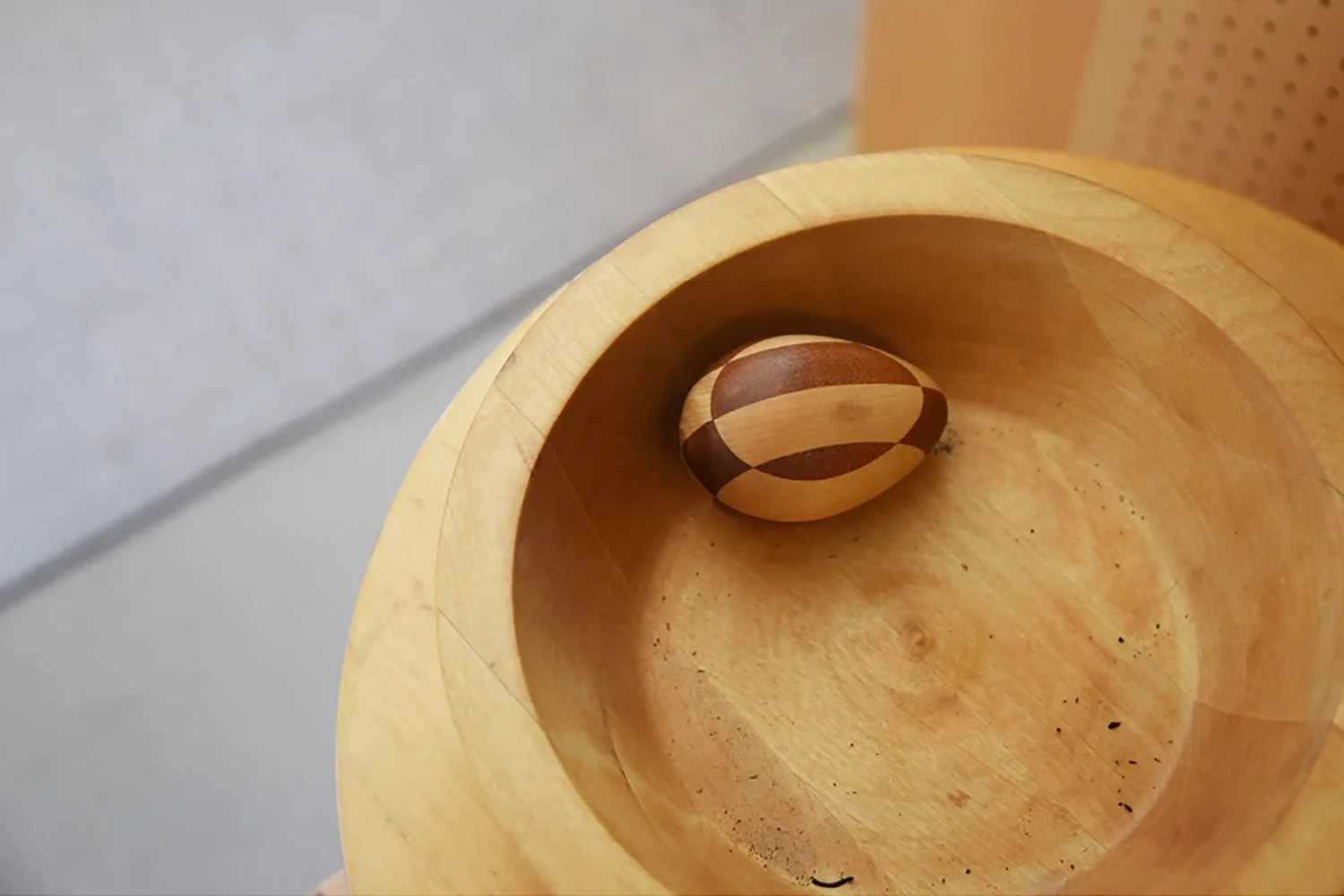
The furniture and decorative objects, too, appear almost like artworks, each with a distinct character of its own. Among them are several design classics: Yrjö Kukkapuro’s Karuselli chair, Alvar Aalto’s Model 401 armchair, Marcel Breuer’s Wassily chair – and Ritva Puotila’s Railway paper yarn carpet.
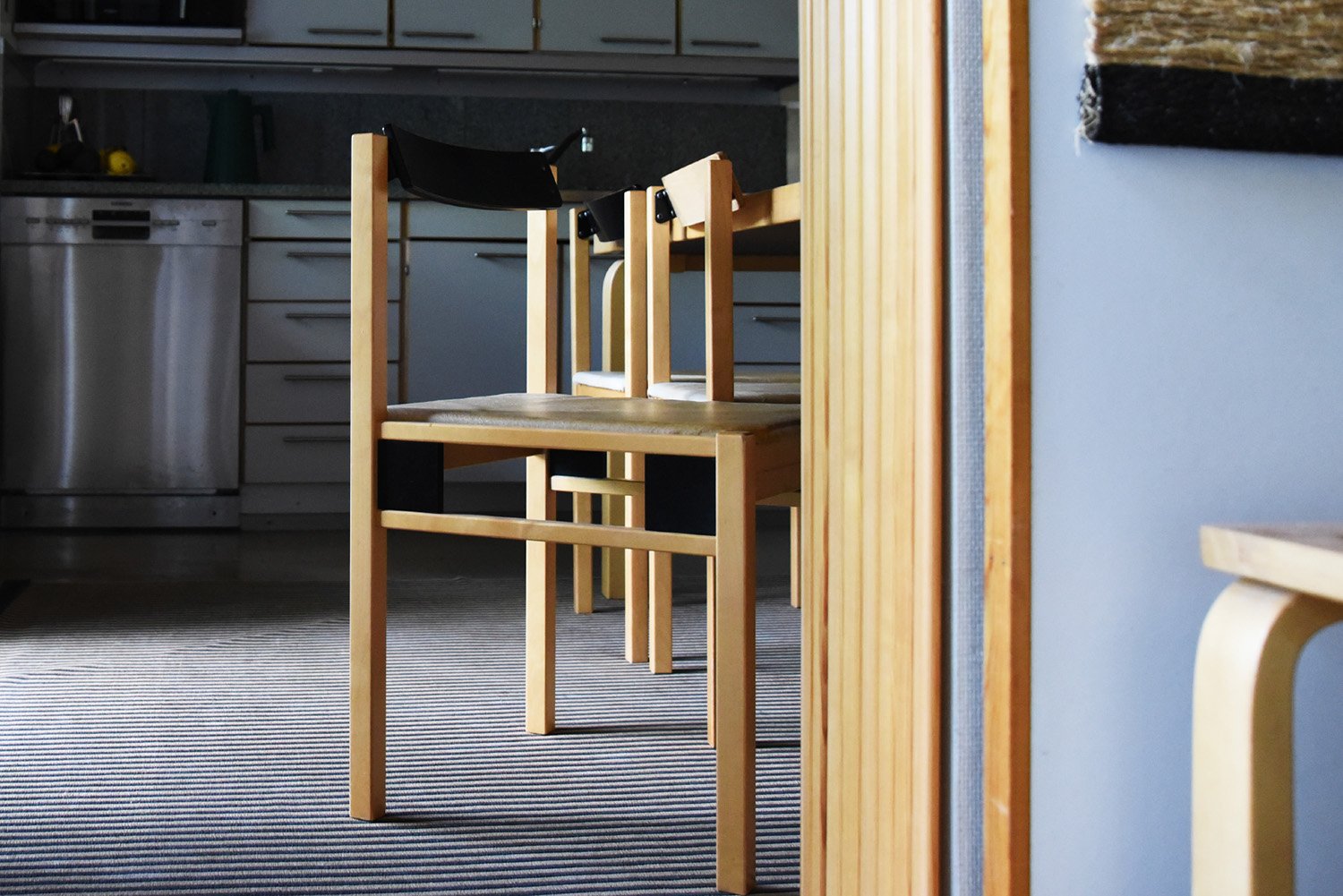
The Railway carpet lies in the Tiirikainens’ kitchen, while a Woodnotes New York carpet adorns the balcony and a Woodnotes magazine rack stands in the bedroom.
Marita and Jarmo Tiirikainen
Although Puotila’s Woodnotes textiles are intended as functional home furnishings, her long artistic career is evident in them as well: an impeccable eye for form and color, and an ability to create compelling rhythms and compositions.
In the Tiirikainens’ home, there is no distinction between art and the other elements of the interior. Everything belongs to the same whole – a home made for living.
An interior guided by emotion
The Tiirikainens moved into their current home in 1978. The house is part of a row-house development in a leafy area of Espoo, and it was designed by Jarmo himself.
“We looked for other interested families to join the project,” Jarmo recalls. He designed the homes, and the housing company was built collectively.
Tiirikainen designed compact two-story homes with open-plan kitchens and generous, light-filled spaces. In their own home, the couple added a loft-like upper level above the living room, yet the room still feels spacious and airy, with part of it left open all the way to the ceiling. The windows overlook a dense, Japanese-inspired garden.
The proportions throughout the house are beautiful and functional – human-scaled. Furnishings are sparse, while art is abundant.
A Woodnotes magazine rack stands in the bedroom.
Yet no individual piece of art or furniture demands attention. Each seems to settle naturally into a larger, breathing whole.
“They were all chosen with emotion,” Marita says. “Or by chance.”
Every piece also carries a unique story. Many of the furnishings previously belonged to “a friend’s friend’s mother” or some similarly indirect acquaintance. The artworks, meanwhile, come from charity sales and auctions. Some were acquired around 25 years ago from a clearance sale of surplus works owned by the Merita Bank Art Foundation.
“There were huge crowds of people going through stacks of paintings, all hoping to make a discovery.”
For the Tiirikainens, a discovery does not necessarily mean a work by a famous artist. A discovery is something that moves them emotionally and evokes a response. Their walls feature works by artists who are not established names in the traditional art world. Yet there are also pieces by highly recognized artists, such as the Roy Lichtenstein triptych upstairs.
Many objects found their way into the Tiirikainens’ home because nobody else wanted them. Others were rescued from recycling centers and flea markets in poor condition and lovingly restored by Marita.
The artworks, meanwhile, come from charity sales and auctions.
The Woodnotes carpets in both their home and summer cottage, however, were no accident. They were purchased intentionally. The carpet beneath the kitchen table was bought more than thirty years ago – although even that one was a second-quality bargain discovered at a sale.
The Woodnotes paper yarn carpet has also aged beautifully. Marita explains that over the years all kinds of stains have been carefully removed from it.
Woodnotes carpets fit anywhere
“I like how Woodnotes carpets allow the rest of the interior to speak,” Marita says. “They don’t demand attention for themselves.”
“I also like how Woodnotes carpets work with all kinds of styles and flooring materials.”
In keeping with 1970s design traditions, the flooring in the Tiirikainens’ home is vinyl.
“There’s more than enough wood elsewhere,” Marita says. “And we also have fiberglass wallpaper, which many people dislike – but I love it.”
All the original materials have been preserved. Over time they have developed a beautiful patina and contribute to the home’s character and sense of soul.
The Woodnotes paper yarn carpet in the kitchen has also aged beautifully. Marita explains that over the years all kinds of stains have been carefully removed from it. The couple have three sons, and the carpet endured plenty during their childhood years.
“The important thing is not to rub stains or wet them with water, because then they spread. You have to try to absorb them out of the rug.”
Giving materials and objects a second life
For the Tiirikainens, part of the appeal of a carpet – or any material object – is the way time adds patina and character.
Jarmo Tiirikainen has spent much of his architectural career specializing in renovation and adaptive reuse projects. For more than thirty years, he has overseen restoration work at Villa Mairea, designed by Alvar Aalto.
“It began with repairs to the flat roof. My licentiate research focused on flat roofs.”
Jarmo also began his career in Alvar Aalto’s architectural office. Although his professional path later branched in many directions, the Villa Mairea project has remained a constant companion. Most recently, he designed public restroom facilities in a former drying room adjacent to the old laundry area in the villa’s basement. The former laundry itself has housed the Mairea Shop for museum visitors for several years.
Showing photographs of the project, Jarmo explains that a beautifully weathered wooden door had been discovered unused somewhere within the building. It has now been given a new life.
Following the same philosophy, Jarmo has rescued all sorts of unlikely objects and transformed them into artistic elements for the home. Forgotten posters and even old drafting tools have become sculptural features.
Marita, meanwhile, transformed her grandfather’s old rocking horse into a sculptural object by preserving only the horse’s head and placing it on a windowsill among other sculptures.
In her studio room, she creates art from old metal clothes hangers. Hanging from the ceiling are magnificent, multi-layered sculptural mobiles in which the hangers are combined with paper clips and small glass elements.
Throughout the Tiirikainens’ home shines a deep respect for materiality. It feels as though the objects and artworks are fellow inhabitants of the house – and in many ways, they are.
We’ve never really had an interior design philosophy,” they say. “The whole has always evolved around some new object.”
And nothing is ever truly finished.
At the moment, a work by Aino Toivettula rests against the wall, waiting to find its place within the home. Here, too, the focus is on material and matter: the work is composed of old copper printing plates that Toivettula once used in her career as a print maker.
“We’ll see where we end up placing it.”
Once the right spot is found, it can stay there. The Tiirikainens do not seek novelty for novelty’s sake. Good things endure. Just as good materials do.